Losing a loved one is hard enough. When the last rites have to be performed at Manikarnika Ghat in Varanasi, families often feel lost, confused, and unsure of what to do next. Many people have heard the name of this ghat but have no idea what actually happens there, what rituals are followed, what documents are needed, or how much it may cost.
This guide is written to answer all these questions in simple language, so that any family, from any part of India, can understand the process without confusion. If you need help at any step, Harish Funeral Services is available round the clock at +91-8174029812 to guide you through the entire process with care and respect.
Manikarnika Ghat sits on the banks of the River Ganga in Varanasi, also known as Kashi or Banaras. For Hindus, it is not just a cremation ground. It is believed to be the place where the soul gets freedom from the cycle of birth and death, known as moksha.
According to popular belief, Lord Shiva himself whispers the Taraka Mantra, the mantra of liberation, into the ear of the departed soul at this ghat. This is why lakhs of families bring their loved ones here every year, even from far away states, just to perform the final rites at this one place.
The ghat gets its name from a legend. It is said that Lord Vishnu once dug a sacred pit here, and an earring (manikarnika) belonging to Goddess Parvati fell into it while Lord Shiva watched. Since then, this spot has held deep religious meaning for millions of people.
Another special thing about this ghat is the Akhand Dhuni, an eternal flame that is believed to be burning continuously for thousands of years. Every single funeral pyre lit here uses fire taken from this eternal flame, and not from a matchstick or lighter.
The actual cremation process at Manikarnika Ghat is carried out by a community called the Doms. This community has been performing this sacred duty for many generations, and it is passed down within families.
The head of this community is often referred to as the Dom Raja. No cremation can begin without fire sourced from them, since they are the traditional custodians of the eternal flame. This is an important part of the tradition and something families should be aware of before they arrive.
Apart from the Doms, priests (pandits) are also present to guide the family through the religious rituals that need to be performed before, during, and after the cremation.
Understanding the process beforehand can help families feel more prepared and less overwhelmed during an already emotional time. Here is how the entire process generally unfolds.
The deceased is usually brought wrapped in a cloth, often orange or white in colour, and carried on a bamboo stretcher. Family members, mostly the male relatives, carry the body while chanting religious phrases. In many cases, the body is first dipped in the holy waters of the Ganga as a final act of purification before cremation.
Before cremation can begin, some basic formalities and paperwork need to be completed. This includes:
| Requirement | Details |
|
Death certificate |
Issued by hospital or local authority |
|
Identity proof of deceased |
Aadhaar card or any valid ID |
|
Registration at the ghat |
Done through the local municipal or ghat authority |
|
Purchase of wood and material |
Wood is sold at the ghat itself, priced by weight |
Many families are not aware of this step and end up spending extra time and money because they don't know the right process or the right people to approach. This is one of the biggest reasons families prefer taking help from an experienced service like Harish Funeral Services, who handle this documentation and coordination on your behalf.
The body is placed near the river for final preparations. Family priests or ghat pandits guide the family through small rituals, which may include applying ghee, sandalwood paste, and placing items like til (sesame seeds) and tulsi leaves on the body.
The wooden pyre is then arranged carefully. The amount of wood used depends on family preference and budget, and prices are usually calculated per kilogram of wood.
Traditionally, the eldest son or the closest male relative performing the last rites gets his head shaved by a barber near the ghat. This act symbolises letting go of ego and material attachment, and marks the beginning of the mourning period for the family.
This is the most significant moment of the ceremony. Fire is taken from the Akhand Dhuni, the eternal flame, and given to the chief mourner, who then lights the pyre. While lighting the fire, certain mantras are chanted by the priest, and the family stands in respectful silence or prayer.
The cremation itself usually takes a few hours to complete, depending on the size of the pyre and the wood used.
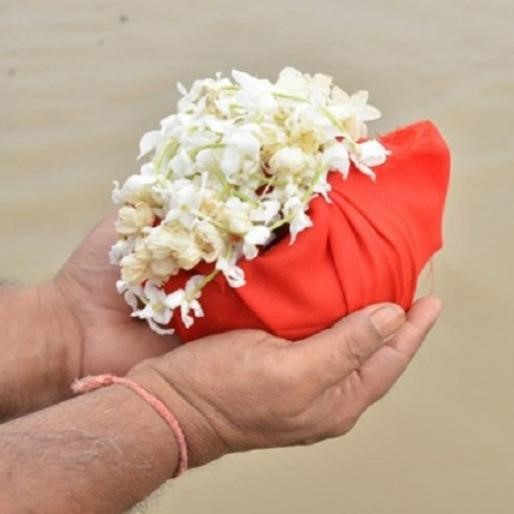
After the cremation is complete, the remaining ashes and bone fragments, known as asthi, are collected. This is usually done a day or two after the cremation, once the pyre has completely cooled down. The asthi is placed in an urn for the next ritual.
The collected ashes are immersed in the River Ganga, ideally at Manikarnika Ghat itself or nearby, as it is believed that the holy river carries the soul towards liberation. Some families choose to immerse the ashes right away, while others prefer to carry them back to their hometown for immersion in a river considered auspicious for their family.
Families often ask what they should bring or arrange before reaching the ghat. Here is a simple checklist:
If arranging all these items yourself feels overwhelming during such a difficult time, Harish Funeral Services can prepare and deliver all the required items, so your family only needs to focus on the rituals and being together.
The cost of cremation at Manikarnika Ghat is not fixed and can vary based on several factors. Here is a general idea:
| Item | Approximate Cost Range |
|
Wood (per kg) |
Varies by season and quality |
|
Priest fees |
Depends on rituals performed |
|
Ritual items and materials |
Varies by family requirement |
|
Transportation of body |
Depends on distance travelled |
|
Additional ceremonies (if any) |
Based on family customs |
Since prices can change and are sometimes negotiated at the ghat itself, it is a good idea to have someone experienced with you who understands the local process. This helps avoid overcharging, which unfortunately does happen to families who are unfamiliar with the area.
No. Manikarnika Ghat is an active cremation ground and a place of deep grief for many families at any given time. Taking photos or videos is considered highly disrespectful and is discouraged, and in many cases, not allowed at all.
Traditionally, women were discouraged from staying at the cremation ground during the actual cremation, but this practice is slowly changing in many families. Many priests today do allow women to be present and even perform the rituals if the family wishes so. It is best to discuss this with the priest beforehand.
From reaching the ghat to completion of cremation, it can take anywhere between three to six hours, depending on the crowd and the wood used. Ash collection happens a day or two later.
Yes, this ghat sees a large number of cremations daily, sometimes over a hundred in a single day. Because of this, there can be some waiting time, and it helps to have local guidance to manage the process smoothly.
Not necessarily. Many families complete the cremation and basic rituals within a day or two and then travel back home. Some choose to stay longer for additional rituals like Pind Daan, which many perform in Varanasi due to its religious significance.
Coming to an unfamiliar city while grieving is never easy. Language differences, unfamiliar routes, local customs, and dealing with vendors can all add unnecessary stress at a time when families should be focusing on saying goodbye to their loved one.
This is exactly where Harish Funeral Services steps in. Here is how the team supports families:
Manikarnika Ghat is located in the old city area of Varanasi, close to the Kashi Vishwanath Temple zone. Since the lanes leading to the ghat are narrow, vehicles usually cannot go all the way to the ghat itself. Families are dropped at a nearby point, such as Godowlia or the Maidagin-Chowk side, and then need to walk through local lanes to reach the ghat.
Because of this, it is helpful to plan extra time for travel, especially during busy hours or festival seasons when the crowd increases.
Manikarnika Ghat is not a tourist spot. It is a place of deep sorrow and deep faith at the same time. If you are visiting to perform the last rites of a loved one, try to stay calm, follow the guidance of the priest, and lean on your family members for support. Grief takes its own time, and there is no need to rush any part of this process.
At such a difficult time, having someone reliable by your side can make a real difference. Harish Funeral Services has helped many families complete the last rites at Manikarnika Ghat with dignity, without the stress of figuring out the process alone.
Whether you need help with:
Our team is available to support you at every step.
Call us anytime at +91-8174029812 and let us take care of the arrangements, so your family can focus on saying a peaceful goodbye.
This guide is meant to help families understand the general process at Manikarnika Ghat. Rituals may vary slightly based on family traditions, region, and the priest performing the ceremony.
Families needing assistance can contact Harish Funeral Services at +91-8174029812. The service team can help families coordinate cremation-related arrangements, transportation, priest services, ritual requirements, and other last-rites support according to their needs.
There is no universal fixed cost for every cremation. Expenses may include wood, priest services, transportation, ritual materials, and other arrangements. Families should confirm current charges and service requirements before proceeding with the cremation.
The Dom community has traditionally played an important role in managing cremation activities at Manikarnika Ghat. Families may also take assistance from local priests or funeral service providers for transportation, ritual materials, wood arrangements, and other required services.
Different types of wood can be used for traditional cremation. The quantity and type depend on the family's arrangements and budget. Wood is generally arranged locally, and costs can vary according to the type and amount required.
The cremation itself commonly takes several hours, although the exact duration varies. Preparation, family rituals, availability of space, wood arrangements, weather, and other local conditions can affect the overall time required.
In traditional cremation practices, the body may be brought to the Ganga for ritual purification before being placed on the funeral pyre. The exact practice can differ according to the family's customs and the guidance of the priest conducting the last rites.
Mukhagni refers to the lighting of the funeral pyre by the chief mourner. Traditionally, this responsibility is often given to the eldest son, although the appropriate person can vary according to family customs, community practices, and circumstances.
The usual process includes bringing the body to the ghat, performing purification and family rituals, preparing the wood pyre, conducting prayers, performing Mukhagni, completing cremation, and later collecting the ashes. Exact rituals depend on family traditions.
Manikarnika Ghat is considered one of the holiest cremation grounds in Hindu tradition. Many families come to Varanasi because of the belief that performing final rites in Kashi can help the departed attain Moksha.
At Manikarnika Ghat, the deceased is brought for Hindu last rites and cremation. The body is generally taken to the Ganga, family rituals are performed, a funeral pyre is prepared, and the chief mourner performs the Mukhagni. Customs can vary by family.