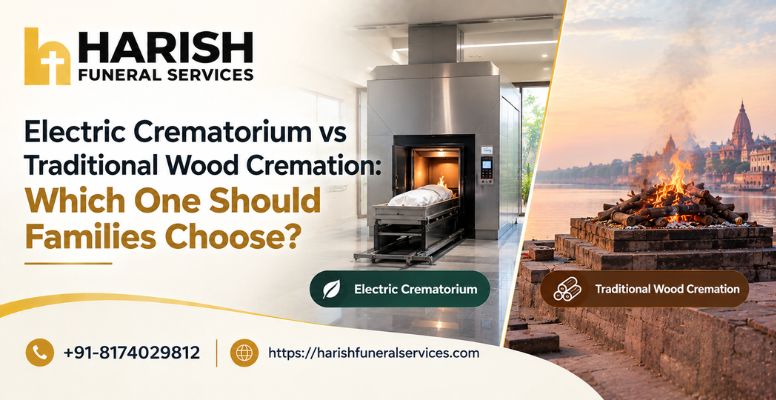
When a family loses someone dear, one practical decision that comes up quickly is the choice between traditional wood cremation and electric cremation. Both methods are widely accepted across India, and each has its own significance, process and practical considerations. Harish Funeral Services has guided many families through this decision, helping them understand what each method involves so they can choose what feels right for their situation and beliefs. This guide breaks down both options in detail, covering process, cost, time, environmental impact and tradition, so families can make an informed choice without confusion during an already emotional time.
Before comparing the two, it helps to understand what each method actually involves.
Traditional wood cremation follows the age-old Hindu custom of placing the body on a wooden pyre and performing the final rites with fire lit by a close family member, usually the eldest son. This method has been followed for generations and carries deep religious meaning for many families.
Electric cremation, sometimes called CNG or gas-based cremation, uses a modern furnace system to complete the cremation process. The body is placed inside a specially designed chamber, and the cremation is completed using electric or gas-powered heat instead of an open wood fire.
Both methods aim to complete the same purpose, the final rites of the deceased, but they differ significantly in process, time and other practical aspects.
Here is a simple side-by-side comparison to help families understand the key differences at a glance.
| Point | Traditional Wood Cremation | Electric/CNG Cremation |
|
Process |
Open wooden pyre with fire lit by family |
Enclosed chamber using electric or gas heat |
|
Time Taken |
Usually 2 to 4 hours |
Usually 1 to 2 hours |
|
Cost |
Generally higher due to wood and material |
Generally more economical |
|
Environmental Impact |
Higher smoke and wood consumption |
Lower emissions and less wood usage |
|
Religious Ritual Scope |
Allows full traditional rituals, including lighting the pyre by hand |
Rituals can still be performed, though lighting is mechanical |
|
Availability |
Available at most cremation grounds |
Available only at select modern crematoriums |
|
Family Involvement |
Family stays close throughout the open process |
Family typically waits outside the chamber area |
|
Ash Collection |
Ashes collected after the fire settles naturally |
Ashes collected after the machine cycle completes |
This table gives a broad view, but each family's decision usually depends on a mix of personal belief, urgency and practical convenience.
Traditional wood cremation has been the standard method followed in Hindu tradition for centuries. It involves a set process that many families are familiar with, even if they have not had to arrange one themselves before.
Key aspects of this method include:
Many families continue to choose this method because it aligns closely with religious teachings and long-standing family tradition. The physical presence of fire and the direct involvement of family members in lighting the pyre holds deep emotional and spiritual meaning for many.
Electric cremation in Lucknow has become increasingly common in Indian cities, mainly due to its practical benefits. It offers a faster and more environment-friendly alternative to the traditional method.
Key aspects of this method include:
This method has gained acceptance over the years, especially among families who want a quicker process or who are conscious about environmental impact. Many crematoriums also allow a short ritual period before the cremation begins, so families do not feel they are skipping important customs.
Time is often an important factor, especially for families managing other responsibilities or those who have travelled from another city.
| Cremation Type | Approximate Time |
|
Traditional Wood Pyre |
2 to 4 hours for the fire to complete its natural process |
|
Electric/CNG Cremation |
1 to 2 hours, depending on the crematorium's equipment |
Electric cremation generally takes less time overall, which can be helpful for families who need to complete the process quickly due to travel plans, work commitments or health concerns among elderly relatives who may find long waiting difficult.
Cost is a practical consideration for most families, even though it is rarely the only deciding factor. Here is a general comparison:
| Cost Element | Traditional Wood Cremation | Electric/CNG Cremation |
|
Wood and Material |
Additional cost for wood, ghee and related items |
Not required |
|
Cremation Ground Charges |
Basic charges apply at most ghats |
Basic charges apply, often lower overall |
|
Priest and Ritual Cost |
Similar for both methods |
Similar for both methods |
|
Overall Cost |
Generally higher due to wood quantity needed |
Generally more economical |
While electric cremation tends to be lighter on the pocket, many families still choose the traditional method regardless of cost, since religious belief plays a stronger role in this decision than expense.
With growing awareness about pollution and resource use, environmental impact has become an important point of discussion for many families and communities.
Families who are environmentally conscious often lean toward electric cremation for this reason, especially in cities where crematoriums offer this modern facility.
For many Hindu families, the religious aspect of cremation carries the most weight in this decision. Traditional wood cremation allows for the complete ritual sequence as described in religious texts, including the symbolic act of lighting the pyre by a family member.
Points to consider on this front:
It often helps to have a brief conversation with a family priest or elder before finalising, especially if there is uncertainty about which method aligns better with family beliefs.
The health and comfort of family members attending the cremation is another practical factor worth considering.
For families with elderly members attending, electric cremation may offer a slightly more comfortable experience simply due to the reduced time and often better facility set-up.
Not every cremation ghat in Lucknow offers both options, so availability can also influence the final decision.
Our team keeps updated information on which cremation grounds in Lucknow currently offer electric facilities, helping families choose a location that matches their preferred method.
Making this decision does not need to be complicated. Here is a simple approach families can follow:
Discussing these points briefly among close family members, even during a stressful time, usually leads to a decision everyone feels comfortable with.
Whichever method a family chooses, Harish Funeral Services provides complete support for both electric cremation service in Lucknow and traditional wood cremation throughout the process. Our services include:
We do not push families toward one method over the other. Our role is to explain both options clearly and support whichever choice the family feels most comfortable with.
Families across Lucknow trust us not just for logistics, but for honest and clear guidance during difficult decisions like this one. Here is what sets Harish Funeral Services apart:
Our aim is simple, to help families make a decision that feels right for them, without pressure or confusion.
If your family is trying to decide between electric cremation and traditional wood cremation in Lucknow, please reach out to us at +91-8174029812. Our team can explain both options in detail, share information on cremation grounds offering each method and arrange every practical step required, from transport to rituals.
Harish Funeral Services stands with families across Lucknow during such moments, offering honest guidance and complete support so the final rites, whichever method is chosen, are carried out with the respect and care they deserve.
First confirm the preferred cremation method and availability at the selected cremation ground. Then arrange the required documents, transportation, and funeral materials. Harish Funeral Services can be contacted at +91-8174029812 for transportation and funeral-service assistance.
Yes, Harish Funeral Services can assist families with transportation of the deceased to a suitable cremation ground in Lucknow. For assistance, contact +91-8174029812 and provide the pickup location, preferred cremation ground, timing, and transportation requirements.
Families should confirm that the electric furnace is currently working, check operating timings, understand applicable charges, and ask about arrangements for funeral rituals. This is especially important because Lucknow crematoriums have experienced periodic equipment breakdowns.
Electric cremation generally uses substantially less wood than a traditional pyre. Lucknow reporting has highlighted reduced wood consumption as one environmental advantage of electric cremation. Families may consider this along with their traditions and the availability of a functioning furnace.
Electric cremation can be chosen by families who are comfortable with the method and whose selected cremation facility supports the required rituals. Families who prefer a traditional wood pyre can follow customary rites using the conventional cremation method.
The cost depends on the cremation centre and the services required. Lucknow Municipal Corporation electric cremation has been reported as free at certain facilities, while wood cremation involves expenses for wood and other materials. Current charges should be confirmed before cremation.
Electric cremation generally takes less time than a traditional wood pyre. Recent reporting from Lucknow notes that conventional cremation can take several hours, while electric cremation may be completed considerably faster when the furnace is operational.
Yes, traditional wood cremation is available at several cremation grounds in Lucknow. Families following customary funeral practices can arrange a wood pyre along with required materials and rituals according to their family traditions and the rules of the selected cremation ground.
Yes, electric cremation facilities are available at selected cremation centres in Lucknow, including Baikunth Dham and other locations. However, furnace availability can change because of maintenance or technical problems, so families should confirm before visiting.
Electric cremation uses an electric furnace to complete the cremation process, while traditional cremation uses a wood pyre. The choice can depend on family customs, availability, personal preferences, crematorium facilities, time, and cost.